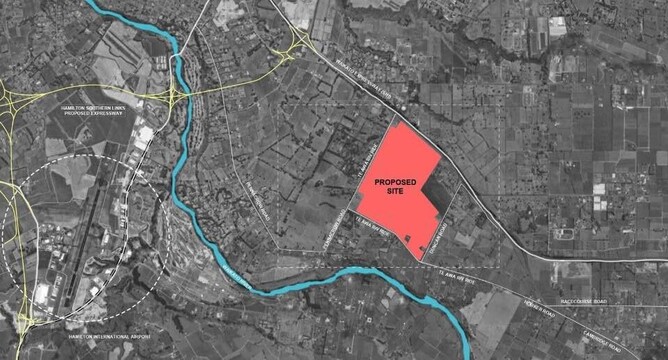
Plans to establish a purpose-built racecourse, training and equine events centre in Tamahere have now been publicly announced, with door-to-door consultation underway and information flyers delivered to nearby households before Christmas. For those living closest to the proposed site, the announcement has prompted a growing list of questions:
How will property values be affected?
What will be lost in terms of Tamahere’s rural character?
What day-to-day changes might residents expect if a large-scale regional facility is built on their doorstep?
Others are asking whether a full economic and environmental impact assessment has been commissioned?
and whether the project’s potential designation as “nationally significant” could see planning processes fast-tracked in ways that limit local influence?
The proposal, led by Waikato Thoroughbred Racing (WTR), would see three Waikato racing clubs amalgamated into a single modern venue on approximately 150 hectares of farmland in Tamahere. The site is bordered by the Waikato Expressway to the north and Hooker Road to the south, between Duncan and Pencarrow Roads.
Funding for the development will be enabled by the sale of assets including the Te Rapa Racecourse, a 50-hectare site increasingly viewed by developers as prime land for medium-density housing and mixed-use urban development.
WTR chief executive Andrew Castles has described the proposal as a necessary step to future-proof the Waikato’s thoroughbred industry, noting the scale of the region’s training operations and the number of livelihoods supported by racing. While the facility would function as a race-day venue, it is also being positioned as a multi-use events and entertainment centre, with an economic impact report currently underway to assess how best to maximise year-round use. Site investigations covering traffic, access, ecology, water, drainage, and geology are also in progress, with further project costs and funding details expected to be developed during 2026.
Waikato District Mayor Aksel Bech has labelled the proposal “nationally significant,” highlighting its proximity to the expressway, Southern Links, and Hamilton Airport, and pointing to opportunities for regional economic growth. For Tamahere residents, however, that designation carries both promise and risk. While the project could bring investment, employment, and infrastructure upgrades, there are concerns about traffic congestion, environmental impacts, loss of rural amenity, and whether local voices will retain sufficient weight if consenting pathways are accelerated under national-significance frameworks.
Representatives from Waikato Thoroughbred Racing and the project’s backers will feature at the Tamahere Community Open Day on 31 January 2026 at the Tamahere Community Centre on Devine Road. This forum provides a vital opportunity for residents, particularly those directly affected, to ask clear, evidence-based questions about what is proposed, what remains undecided, and how community interests will be protected.
Early, transparent engagement will play a decisive role in determining whether the project evolves as a genuinely shared regional asset, or becomes a point of long-term contention for Tamahere or does not proceed at all.
ENDS:
